
Krause 131669
KRAUSE STABILO+S Professional Multi-Purpose Ladder Instruction Manual
Model: 131669
Inleiding
This manual provides essential instructions for the safe and effective use, setup, and maintenance of your KRAUSE STABILO+S Professional Multi-Purpose Ladder. This durable aluminum ladder is designed for various applications, offering versatility as a stepladder, extension ladder, and leaning ladder. Please read this manual thoroughly before initial use and retain it for future reference.
Veiligheidsinligting
WARNING: Failure to follow these safety instructions can result in serious injury or death.
- Always inspect the ladder for damage or defects before each use. Do not use a damaged ladder.
- Ensure all locking mechanisms are fully engaged before climbing.
- Plaas die leer op 'n stewige, gelyke en glyvaste oppervlak.
- Maintain three points of contact (two hands and one foot, or two feet and one hand) while climbing or descending.
- Do not overreach. Keep your body centered between the side rails.
- Do not use the ladder near electrical wires or equipment.
- Moenie die maksimum vragvermoë van 200 kg oorskry nie.
- Ensure proper angle for leaning ladders (approximately 75 degrees).
- Dra geskikte skoene en vermy los klere.
- Do not use the ladder in high winds or adverse weather conditions.
Opstelling en konfigurasie
The KRAUSE STABILO+S ladder offers multiple configurations for various tasks.
1. Stepladder (A-Frame) Configuration
To set up the ladder as a stepladder, unfold the sections until they form an 'A' shape. Ensure the spreader bars or locking hinges are fully engaged and locked into place. The base stabilizers should be firmly on the ground.

Image: The KRAUSE STABILO+S ladder configured as a stable A-frame stepladder, ready for use.
2. Stepladder with Extension Configuration
For increased height while maintaining the stability of a stepladder, extend one section upwards from the A-frame. Ensure all locking pins for the extension are securely fastened. The extended section should be vertical and aligned with the base.
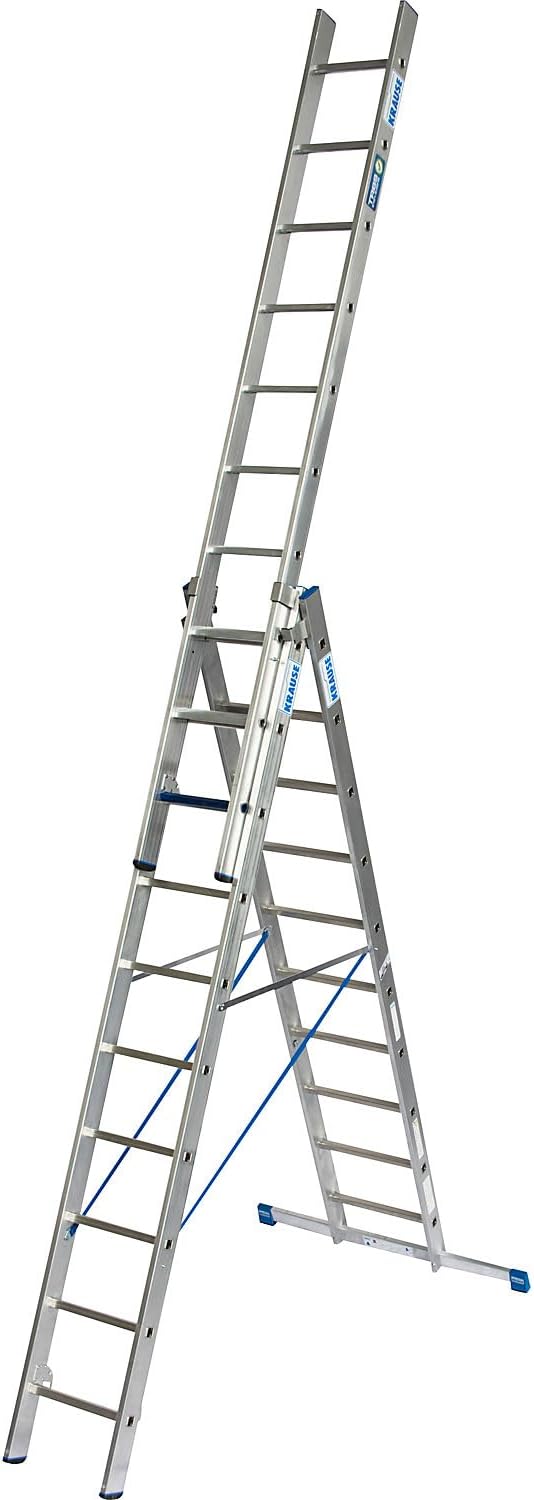
Image: The KRAUSE STABILO+S ladder set up as an A-frame with an additional section extended vertically, providing extra reach.

Beeld: 'n Gedetailleerde view of the KRAUSE STABILO+S ladder in its A-frame extended configuration, highlighting the secure locking mechanisms and stable base.
3. Extension Ladder Configuration
To use the ladder as a full extension ladder, fully extend all sections and lock them into place. Ensure the ladder is leaning against a stable surface at the correct angle (approximately 75 degrees from the horizontal). The top of the ladder should extend at least 1 meter (3 rungs) above the landing point.

Image: The KRAUSE STABILO+S ladder fully extended and leaning against a wall, demonstrating its maximum reach as an extension ladder.
4. Two Separate Leaning Ladders Configuration
The ladder can be separated into two individual leaning ladders. This configuration is useful for tasks requiring two separate access points or for creating a scaffold base (with appropriate accessories, not included). Ensure each section is stable and properly secured before use.

Image: The KRAUSE STABILO+S ladder disassembled into two distinct sections, one configured as a short leaning ladder and the other as a compact A-frame.
Bedryfsinstruksies
Always ensure the ladder is correctly configured for the task at hand and all safety precautions are observed.
- Klim: Face the ladder when climbing or descending. Use both hands to grip the side rails or rungs.
- Werk: Keep your belt buckle (navel) within the side rails. Avoid pushing or pulling objects while on the ladder, as this can destabilize it.
- Plasing: For leaning ladders, ensure the top rests against a solid, stable surface. For stepladders, ensure all four feet are firmly on the ground.
- Stabiliteit: Never move a ladder while someone is on it. Ensure the area around the base of the ladder is clear.

Image: A person safely using the KRAUSE STABILO+S ladder in its A-frame extended configuration for a task, demonstrating proper usage and stability.
Onderhoud
Gereelde onderhoud verseker die lang lewensduur en veilige werking van u leer.
- Skoonmaak: Maak die leer gereeld skoon met advertensieamp cloth to remove dirt, grease, or other contaminants. Avoid harsh chemicals that could damage the aluminum.
- Inspeksie: Periodically check all rungs, side rails, locking mechanisms, and feet for wear, damage, or loose components. Pay close attention to hinges and pivot points.
- Berging: Store the ladder in a dry, protected area away from extreme temperatures and direct sunlight. Ensure it is stored in a way that prevents accidental falling or damage.
- Herstelwerk: Do not attempt to repair damaged parts yourself. Contact a qualified technician or the manufacturer for genuine replacement parts and professional repair.
Probleemoplossing
- Die leer voel onstabiel: Ensure all locking mechanisms are fully engaged. Check that the ladder is on a firm, level surface. Verify the correct angle for leaning ladders.
- Difficulty extending/retracting sections: Clean the rails and rungs to remove any debris. Apply a small amount of silicone-based lubricant to the sliding parts if necessary, avoiding rungs.
- Beskadigde komponente: Immediately cease use of the ladder. Do not attempt temporary repairs. Contact customer support for guidance on replacement parts or professional repair.
Spesifikasies
| Kenmerk | Detail |
|---|---|
| Handelsmerk | Krause |
| Modelnommer | 131669 |
| Materiaal | Aluminium |
| Number of Rungs | 3 x 10 (sections) |
| Produk afmetings | 490 x 12.67 x 465 cm (approximate, varies by configuration) |
| Item gewig | 25.5 kg |
| Laai kapasiteit | 200 kg |
| Kleur | Blue (accents) |
Waarborg en Ondersteuning
For warranty information, technical support, or to purchase genuine replacement parts, please refer to the official Krause webwebwerf of kontak u gemagtigde handelaar. Bewaar u aankoopbewys as bewys van aankoop.
Ask a question about this manual
Ask about setup, troubleshooting, compatibility, parts, safety, or missing instructions. Manuals+ will review the question and use this page’s manual context to help answer it.