
Atago 2323 MASTER-2M
Atago MASTER-2M Brix Refraktometer Instruksiehandleiding
Model: 2323 MASTER-2M
Produk verbyview
Die Atago MASTER-2M Brix Refractometer is a precision instrument designed for measuring the concentration of various solutions, primarily focusing on Brix values. It is suitable for applications such as measuring the concentration of fruits, beverages, and canned goods, determining the total solid content of syrups, vinegar, and sauces, and assessing the quality of vegetable, fruit, and grass tissues. This refractometer is also utilized in chemical, agricultural, manufacturing process control, quality control, and pre-shipment inspections.
Constructed from Polybutylene terephthalate (PBT) thermoplastic, the MASTER-2M features a screw potentiometer for calibration and an easy-to-read internal scale, ensuring excellent resolution and precision accuracy across its Brix range of 28.0 to 62.0%.
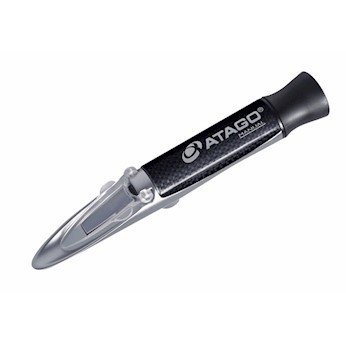
Image: The Atago MASTER-2M Brix Refractometer, a handheld device with a clear prism and an eyepiece for reading measurements. The body is dark grey with the 'ATAGO' logo visible.
Opstelling
- Uitpak: Carefully remove the refractometer from its packaging. Inspect for any visible damage.
- Vertroudmaking: Identify the main components: the prism, daylight plate, calibration screw, and eyepiece.
- Aanvanklike skoonmaak: Before first use, gently clean the prism and daylight plate with a soft, lint-free cloth.
- Kalibrasie:
- Ensure the refractometer is at room temperature (20°C / 68°F).
- Open the daylight plate. Place a few drops of distilled water onto the prism.
- Close the daylight plate gently, ensuring the water spreads evenly without air bubbles.
- Look through the eyepiece towards a light source. The boundary line between the blue and white fields should be visible.
- Use the calibration screw (usually located near the eyepiece or prism) to adjust the boundary line to the '0' mark on the scale.
- Wipe the prism and daylight plate dry with a soft cloth after calibration.
Bedryfsinstruksies
- SampVoorbereiding: Maak seker jou sample is well-mixed and free of solid particles that could scratch the prism. The sample should be at a consistent temperature, ideally room temperature, for accurate readings.
- Applying the Sample: Open the daylight plate. Place 2-3 drops of the liquid sample onto the surface of the main prism.
- Closing the Daylight Plate: Gently close the daylight plate so that the liquid spreads evenly across the entire surface of the prism without air bubbles or dry spots.
- 'n Lesing Neem:
- Point the prism end of the refractometer towards a bright light source (e.g., daylight or a lamp).
- Look through the eyepiece. You will see a circular field with a scale.
- The boundary line between the upper blue field and the lower white field indicates the Brix value on the scale.
- Read the value where the boundary line intersects the scale.
- Skoonmaak na gebruik: Immediately after each measurement, clean the prism and daylight plate thoroughly with a soft, damp cloth or tissue. Dry completely with a clean, lint-free cloth. Residual sugar or other substances can crystallize and damage the prism.
Onderhoud
- Skoonmaak: Always clean the prism and daylight plate immediately after each use. Use only soft, lint-free cloths. For stubborn residues, a small amount of distilled water can be used, but avoid harsh chemicals or abrasive materials.
- Berging: Store the refractometer in a cool, dry place, away from direct sunlight and extreme temperatures. Keep it in its protective case when not in use to prevent dust accumulation and physical damage.
- Vermy onderdompeling: Do not immerse the refractometer in water or any other liquid. It is not waterproof.
- Hanteer versigtig: The prism is a delicate optical component. Avoid dropping the instrument or subjecting it to strong impacts.
- Gereelde Kalibrasie: Calibrate the refractometer with distilled water before each use or at least daily to ensure accuracy.
Probleemoplossing
- Reading is Inaccurate:
- Ensure the refractometer has been properly calibrated to '0' with distilled water.
- Kyk of die sample and refractometer are at a stable room temperature. Significant temperature differences can affect readings.
- Verify the prism and daylight plate are clean and free of residue or scratches.
- Boundary Line is Faint or Unclear:
- Ensure sufficient light is directed towards the prism.
- Kyk of die sample is spread evenly across the prism without air bubbles.
- Adjust the focus of the eyepiece by rotating it until the scale and boundary line are sharp.
- Air Bubbles in Sample:
- Gently lift the daylight plate and re-close it, allowing the sample to spread.
- Ensure only 2-3 drops of sample are used; too much or too little can cause issues.
- Scale Appears Dirty:
- This usually indicates dirt or residue on the prism or daylight plate. Clean thoroughly as per maintenance instructions.
- If the internal optics appear dirty, do not attempt to disassemble the unit. Contact customer support.
Spesifikasies
| Kenmerk | Spesifikasie |
|---|---|
| Modelnommer | 2323 MASTER-2M |
| Brix Range | 28.0 tot 62.0% |
| Akkuraatheid | ±0.2% Brix |
| Resolusie | 0.2% Brix |
| Materiaal | Polybutylene terephthalate (PBT) thermoplastic |
| Pakket afmetings | 10.58 x 2.88 x 1.45 duim |
| Item gewig | 0.01 onse (ongeveer) |
| Vervaardiger | Cole-Parmer |
Waarborg en Ondersteuning
This Atago refractometer is manufactured to high quality standards. For specific warranty details, please refer to the warranty card included with your product or visit the official Atago website. Typically, instruments are covered against defects in materials and workmanship for a specified period from the date of purchase.
For technical support, calibration services, or repair inquiries, please contact your authorized Atago distributor or the manufacturer directly. When contacting support, please have your model number (2323 MASTER-2M) and purchase information readily available.
Let wel: Ongemagtigde herstelwerk of wysigings kan die produkwaarborg ongeldig maak.
Ask a question about this manual
Ask about setup, troubleshooting, compatibility, parts, safety, or missing instructions. Manuals+ will review the question and use this page’s manual context to help answer it.