
1. Inleiding en oorview
The Orion 8893 Field Flattener is designed to correct field curvature in short, optically fast refractor telescopes. Field curvature can cause stars at the edges of astrophotography images to appear elongated or out of focus, especially when using CCD/CMOS imagers and DSLRs with APS-C sized or full-frame sensors. This field flattener ensures sharp, pinpoint stars across the entire image frame.
This device is compatible with refractor telescopes having focal lengths between 400mm and 660mm, and focal ratios ranging from f/5 to f/7.5. It features fully multi-coated, 38mm clear aperture optics to maximize image contrast and minimize vignetting. The design includes interchangeable male M42 (standard T-thread) and M48 (wide T-thread) camera adapters, allowing for broad compatibility with various camera setups. A T-ring specific to your camera model is required and sold separately.
An official video from Orion Telescopes & Binoculars introducing the features and benefits of the Orion Field Flattener for Short Refractors.
2. Opstelling en installering
Proper installation of the field flattener is crucial for optimal performance. Follow these steps to integrate it into your imaging train:
- Prepare the Field Flattener: The Orion 8893 Field Flattener comes with interchangeable M42 and M48 camera adapters. Select the appropriate adapter for your camera's T-ring. Thread the chosen adapter onto the field flattener.
- Attach T-Ring to Camera: Secure your camera's T-ring (sold separately) to your DSLR or dedicated astronomy camera. Ensure it is firmly attached.
- Connect Camera to Field Flattener: Thread the field flattener (with the attached adapter) onto your camera's T-ring. This creates a secure connection between your camera and the field flattener.
- Insert into Focuser: The field flattener is designed to fit into 2-inch focuser drawtubes. Carefully insert the assembled camera and field flattener into your telescope's 2-inch focuser. Secure it with the focuser's thumbscrews.
- Backfocus Requirement: A critical backfocus distance of 55mm is required between the rear lens of the field flattener and your camera's sensor to achieve proper field flattening. Depending on your camera and T-ring combination, you may need to use additional spacers (not included) to achieve this precise distance. Refer to your camera's specifications for its sensor's flange focal distance.
- Filterinstallasie: The barrel of the field flattener is threaded for 2-inch filters. You can thread a light pollution filter or other imaging filters directly onto the field flattener before inserting it into the focuser.

Image: The Orion 8893 Field Flattener, a black cylindrical optical accessory with a threaded end and multi-coated lenses visible.
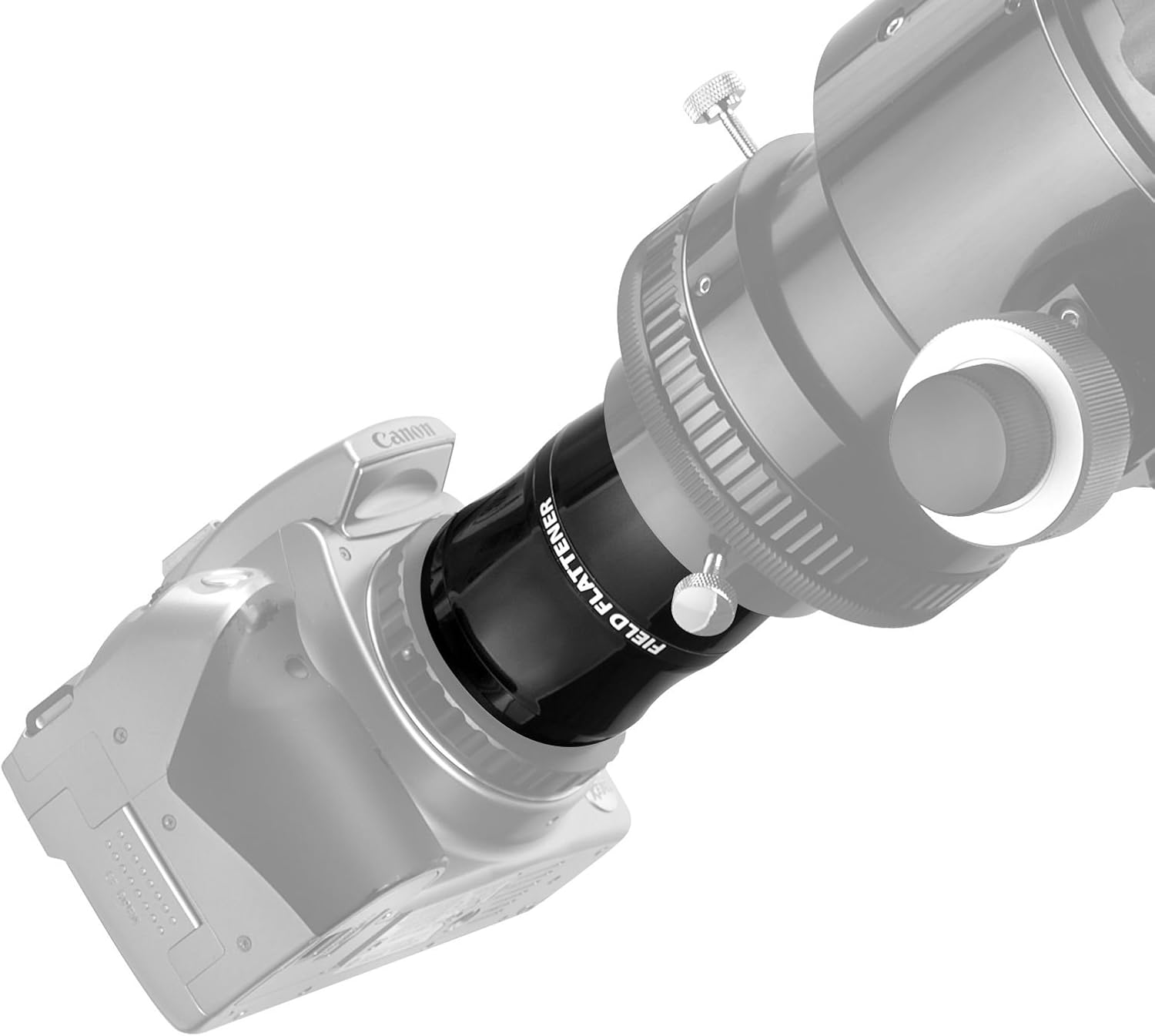
Image: The Orion 8893 Field Flattener connected to a camera body, which is then inserted into the focuser of a telescope. This illustrates the typical setup for astrophotography.
3. Bedryfsinstruksies
Once the Orion 8893 Field Flattener is correctly installed in your imaging train and the backfocus is set to 55mm, its operation is passive. It works by optically correcting the inherent field curvature of your refractor telescope, ensuring that light rays from distant objects are focused evenly across your camera's sensor.
- Fokus: Focus your telescope as you normally would for astrophotography. The field flattener does not change the focal length of your telescope, so your focusing procedure remains the same.
- Beeldvorming: Proceed with your astrophotography session. The field flattener will ensure that stars appear sharp and round from the center to the very edges of your captured images, eliminating the common issue of elongated or distorted stars at the periphery.
- Gebruiksnota: This field flattener is designed specifically for photographic use. It is not intended for visual observing.

Image: A vibrant astrophotography image featuring the Orion Nebula and surrounding star fields, demonstrating the sharp, flat-field results achievable with a field flattener.
4. Onderhoud
Proper care and maintenance will ensure the longevity and optimal performance of your Orion 8893 Field Flattener.
- Skoonmaak van optika: Use a soft, lint-free cloth specifically designed for optical surfaces. For stubborn dust, use a blower brush first. For smudges or fingerprints, apply a small amount of optical cleaning fluid to the cloth, not directly to the lens, and gently wipe in a circular motion from the center outwards. Avoid touching the optical surfaces with bare hands.
- Berging: When not in use, store the field flattener in a clean, dry environment, preferably in its original packaging or a padded case. Ensure both ends are capped to prevent dust accumulation. Avoid extreme temperatures and high humidity.
- Hantering: Always handle the field flattener by its barrel, avoiding direct contact with the optical elements.
5. Probleemoplossing
If you encounter issues while using your field flattener, consider the following common problems and solutions:
- Stars still elongated at edges:
- Check Backfocus: The most common cause. Ensure the 55mm backfocus distance between the field flattener's rear lens and your camera sensor is precisely met. Small deviations can significantly impact performance.
- Telescope Compatibility: Verify that your refractor's focal length (400mm-660mm) and focal ratio (f/5-f/7.5) fall within the recommended range for this field flattener.
- Camera Sensor Size: While the flattener is designed for various sensors, extremely large full-frame sensors might still show minimal edge distortion with some telescope combinations.
- Vignetting (dark corners in images):
- Check Clear Aperture: The flattener has a 38mm clear aperture. Ensure your imaging train components (T-ring, camera adapter) do not introduce additional restrictions.
- Filter Thickness: Overly thick filters can sometimes contribute to vignetting.
- Sensor Grootte: Larger camera sensors are more prone to vignetting, especially with shorter focal length telescopes.
- Difficulty achieving focus:
- Terugfokus: Incorrect backfocus can make it difficult to reach prime focus. Re-check your spacing.
- Focuser Travel: Ensure your telescope's focuser has enough inward and outward travel to accommodate the imaging train.
6. Spesifikasies
| Kenmerk | Spesifikasie |
|---|---|
| Modelnommer | 8893 |
| Handelsmerk | Orion |
| Verenigbaarheid | Short, optically fast refractor telescopes with 400mm to 660mm focal length and f/5 to f/7.5 focal ratios |
| Focuser Compatibility | 2-inch focusers |
| Terugfokusvereiste | 55 mm |
| Duidelike diafragma | 38 mm |
| Optical Elements | 2-element, fully multi-coated |
| Camera Adapters Included | M42 (standard T-thread) and M48 (wide T-thread) |
| Filtreer drade | 2-inch (M48) |
| Gewig | 7.5 onse (ongeveer 212 gram) |
| Optiese buis lengte | 3 duim |
7. Waarborg en Ondersteuning
For information regarding the product warranty, please refer to the warranty documentation included with your purchase or visit the official Orion Telescopes & Binoculars webwebwerf. Waarborgbepalings en -voorwaardes kan wissel.
If you require technical assistance, have questions about setup, or need troubleshooting guidance beyond what is provided in this manual, please contact Orion customer support:
- Orion Telescopes & Binoculars Official Webwebwerf: www.telescope.com
- Verwys na die webwebwerf vir huidige kontakinligting, insluitend telefoonnommers en e-posondersteuning.